With a sound concept and a quality product in place, it’s time for your emerging brand to start thinking about the next steps, but raising funds is often a critical hurdle to overcome. In this four-part series, Marc Levit, Founder of ML Advisory and ForecastEasy, breaks down the process of securing capital. From identifying sources of capital to setting valuations, Levit lends his expertise and perspective every step of the way.
In the first video of the series, Levit assists in identifying potential sources of capital at the startup level. Levit uses the example of Ava, a fictional RTD entrepreneur, to explain why one’s immediate support network should be the best resource during the initial rounds of fundraising.
In the second edition of Raising Funds 101, Levit explains the steps to projecting your brand’s costs and revenue streams when determining cash needs. He also discusses the advantages of breaking your financial forecast down into digestible bites so prospective investors can see what’s driving your brand’s growth.
In his third lesson, Levit takes a look at some of the financial instruments that startups have at their disposal to raise capital. He breaks down deal structures like convertible debt, SAFE, and priced round agreements so that founders have an idea of the available methods for securing funding.
In the final installment of Raising Funds 101, Marc Levit helps brand owners set a strong valuation for early early-stage grants. From keeping a keen eye on comparable valuations of similar startups to identifying peripheral metrics that indicate your brand’s potential, Levit offers a path to accurately calculating your brand’s value.
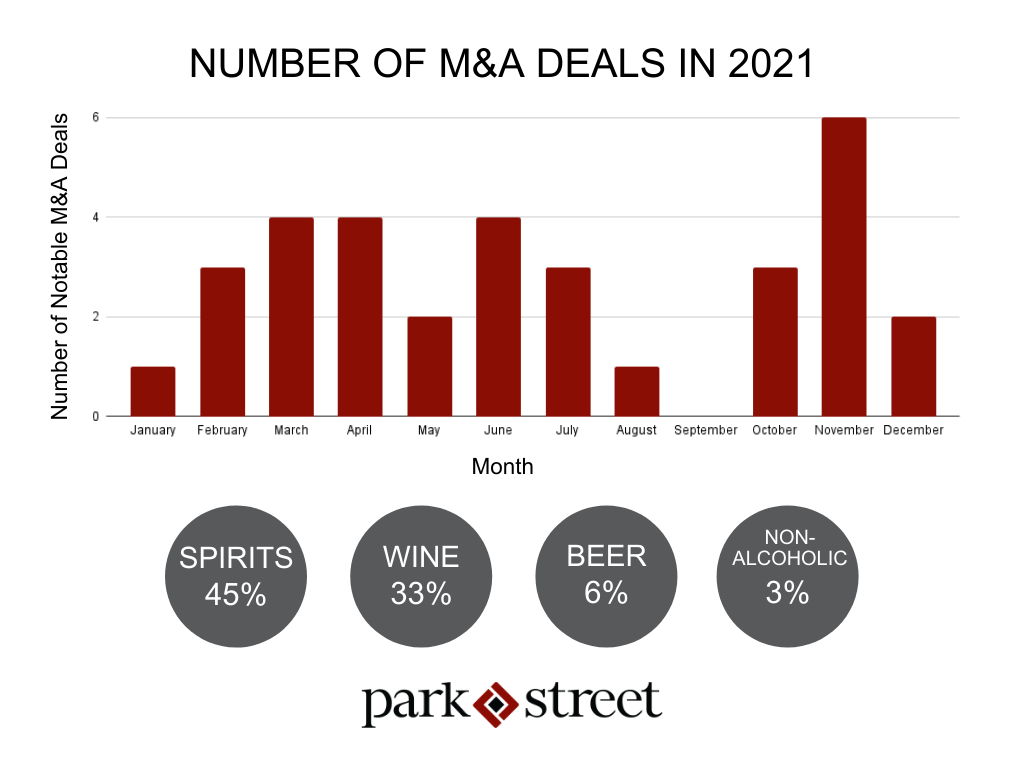
Mergers & acquisitions in the beverage alcohol space continued apace in 2021 as strategic buyers adjusted their portfolios to meet demand for new consumer trends like canned cocktails, hard seltzer, and ecommerce.
By our count, there were 33 U.S-centric beverage alcohol deals this year led by spirits (15), followed by wine (11), beer (2) and non-alcoholic beverages (1). There was also an uptick in M&A for e-commerce platforms, with four major deals going through this year. This is a clear shift from 2020 when M&A for e-commerce was quite low.
While smaller, bolt-on acquisitions have made up the vast majority of deals leading up to the pandemic, we have seen a noteworthy increase in major acquisitions this year. There were four deals–in both wine and ecommerce–that crossed the billion dollar milestone.
Below is a roundup of the most notable beverage alcohol M&A deals in 2021.
As the year draws to a close, we are taking a look back at some of the biggest news stories and most popular content pieces of 2021. From supply chain issues to the elimination of E.U. tariffs and the rise of the direct-to-consumer space, 2021 was an eventful year that ended with another year of growth in the beverage alcohol industry.
As U.S. distillers faced an ongoing shortage in glass bottles, industry professionals took time to discuss strategies that could save time, money, and future headaches.
Park Street Companies once again teamed with the American Craft Spirits Association (ACSA) to develop and release the fifth annual Craft Spirits Data Project to track the long-term growth of the U.S. craft spirits category.
Readers were hungry for information on any changes to the tax code after Congress made the Craft Beverage Modernization and Tax Reform Act (CBMA) permanent.
In this series, we examined 2020 data from Beverage Information Group to determine the top ten markets in the U.S. across popular spirits categories including Whiskey, Rum, Tequila, RTDs, and Gin.
In this video, Sarah Nagel Sisisky, Park Street’s Director of Client Development, explains why the TTB added several new standards of fill for beverage alcohol and what brand owners needed to know about the changes.
Thirstie CEO Devaraj Southworth sits down with Tanteo Tequila’s CEO Neil Grosscup to discuss how e-commerce contributes to the company’s goal of always striving to better directly communicate with consumers.
Jose Chao, CEO of COPPA Cocktails talks through the importance of carefully preparing for your relationships with suppliers and distributors before your product goes to market.
Andrea Sengara, Campari America’s Vice President of Marketing, shares her insights on choosing a digital platform that works best for your company, key ways to improve your digital performance, and driving online conversions.
Adriana McKinnon, Park Street’s Director of Logistics, explains some of the effects on the supply chain this year and advises brand owners on preparing for the unknown.
President Biden issued an executive order directing his administration to assess threats to competition and barriers to entry across a range of industries, including beverage alcohol.
The U.S. and E.U. negotiated an end to their tariff dispute on European steel and aluminum, effectively eliminating their retaliatory tariffs on distilled spirits.
Port congestion across the globe, and particularly in U.S. ports, is expected to continue causing headaches for freight and logistics carriers for the foreseeable future.
Jose Cuervo owner Becle secured a $150 million loan to pay for the remaining stake in the company behind Conor McGregor’s Proper No. Twelve Irish whiskey.
Gin consumption declined 1.5% last year in the U.S. with the category selling just under 10 million cases. The U.S. spent over $2.9 billion of its retail dollars on the category last year, accounting for 3.0% of the total distilled spirits retail spending in the country.
The top growing brands in the category were led by the likes of Hendrick’s, Aviation and The Botanist, all of which were up double-digits for the year.
The top three markets for gin consumption on a per capita basis were Washington D.C., New Hampshire, and Delaware at 149, 121, and 74 cases sold per 1,000 adults, respectively. We took a closer look at the 2021 data from Beverage Information Group to determine the top ten markets for gin consumption overall based on nine-liter cases sold.
1. California: 1.2 Million Cases
The Golden State represented nearly 12% of the share of gin consumed by the U.S. in 2021.
2. Florida: 757k Cases
The state of Florida saw $310 million in retail spending on gin in 2021, accounting for 4% of the state’s distilled spirit spending.
3. New York: 566k Million Cases
New York City consumed 202k cases of gin in 2021 and the New York-Newark-Edison area was the top metropolitan area in the country for gin consumption.
4. Georgia: 555k Cases
Georgia was the fourth-largest consumer of gin per capita, with over 71 cases consumed per 1,000 Georgians.
5. Texas: 455k Cases
Though it sneaks into the top five, Texas ranked 48th in the country in per capita consumption with only 22 cases consumed per 1,000 Texans.
6. Illinois: 402k Cases
Illinois saw its gin consumption decline by just over 2,000 cases or -0.6% from 2020 to 2021.
7. New Jersey: 396k Million Cases
New Jersey was also in the top ten for per capita consumption at 62 cases consumed per 1,000 adults.
8. Maryland: 313k Cases
Maryland was another state in the top five for gin consumption, with 72 cases consumed per 1,000 adults.
9. Michigan: 283k Cases
Michigan represented the third largest control state in the country for gin consumption in 2021.
10. North Carolina: 279k Cases
Gin consumption in North Carolina declined less than any other control state in our top 10, -1.7% from 2020.
The premium spirits ecommerce platform ReserveBar announced today that it has reached an agreement to acquire Minibar Delivery, a leading delivery marketplace for wine, spirits, beer, RTDs, and more. Minibar Delivery is currently partnered with more than 2,800 retailers nationwide, including 7-Eleven. The move will allow ReserveBar to leverage Minibar’s network to expand retailer fulfillment and accelerate its introduction of on-demand delivery.
The two companies will combine their retailers, customer base, and technology under the merger, expanding retailer locations to over 5,000 by the end of next year and serving virtually all legal drinking age consumers in states that permit shipping and delivery of beverage alcohol. The agreement also accelerates ReserveBar’s deployment of its API technology allowing third parties to offer customers the opportunity to purchase beverage alcohol online.
A greater selection of products will now be offered on Minibar, including limited editions, new launches, and ReserveBar’s personalized and engraved bottle. Under the agreement, Lindsey Andrews will continue as CEO of Minibar Delivery and report to Lindsay Held, CEO of ReserveBar, who will also hold the title of Executive Chairman of Minibar Delivery.
“As a pioneer in the industry, we’re eager to continue our expansion and innovation leadership. ReserveBar is, at its core, a technology company, and we are excited that our planned technology integrations will be extremely powerful for both companies, our partners, and our customers. The Minibar Delivery acquisition supports our strategic growth across other fronts, including retail footprint expansion, local delivery, consumer data, and business intelligence, and, importantly, talent. They have fantastic people, and we’re excited to have them as part of the ReserveBar family,” said Derek Correia, President of ReserveBar.