If your RTD brand is going to get off the ground, it’s necessary to know what consumers are looking for and find a way to connect with them. If your brand can find ways to improve upon the consumer experience within the category, you’re off to a great start.
In this talk, Lawrence Cisneros, CEO of Drnxmyth, broke down the harmony between his brand and the authentic cocktail experience consumers are after. He talks through the technical side of how his product became the first to incorporate fresh juice into their RTD beverage and how this has opened up new opportunities for his brand to can a well-crafted consumer experience.
“For us, ingredients were the key,” explains Cisneros. “Really understanding what consumers want is a tricky thing and you sometimes have to think about it before they even realize what they want.”
The White Claw craze in the summer of 2020 brought with it increased consumer interest in the RTD category. Consumers at the time, however, did not fully understand what they were drinking at the time.
When Amanda Victoria, co-founder and CEO of Siponey, took a look at the RTD landscape she was disappointed by the lack of transparency and quality surrounding the contents of canned beverages. In this talk, Victoria reveals how an emphasis on premiumization and quality ingredients have helped to define the early success of her brand.
“What is inside of the can and why can’t we talk about what’s coming into the can more,” asks Victoria. “Also understanding that cans come from the world of soda, and beer of course, and a lot of synthetic processed ingredients.”
In 2020, the beverage alcohol industry was catapulted into the future with e-commerce seeing 10 years-worth of growth in three months, according to estimates from direct-to-consumer platform Drizly. The current trends are expected to continue, with total alcohol e-commerce in the U.S. forecasted to grow six-fold between 2019 and 2024, according to IWSR.
This shift has provided a unique opportunity for smaller brands to level the playing field against international companies that dominate the majority of physical shelf space. With this in mind, we put together a guide on how to build an e-commerce foundation from some of the guests on Park Street University.
“You hear a lot of people saying ‘you can’t build a brand online, you have to build it in a bar’, which I think is very old thinking,” says Elwyn Gladstone, founder of Biggar & Leith, which sold Malfy Gin to Pernod Ricard in 2019. “Your opportunity to explain the brand, and to sell your story, and to get the perfect imagery and control everything is absolutely perfect online.”
A Guide to DTC E-commerce Models
There are three primary models for direct-to-consumer beverage alcohol sales, all of which work through the three-tier system.
On-Demand Delivery model, which includes companies like Drizly, GoPuff, and Minibar. This model was the forerunner of DTC within the alcohol space. These companies rely on a network of local retailers to deliver items purchased through their respective apps.
White Label model, which includes Speakeasy, Thirstie, Passion Spirits, among others, allow consumers to purchase from a digital storefront embedded in a brand’s website and fulfilled by local retailers.
Marketplace model, applied by companies such as Vivino and ReserveBar, are very similar to white label models, but allows the customer to purchase multiple brands from a digital storefront.
Get to Know the Modern E-Commerce Consumer
E-commerce consumers tend to be younger and more digitally-savvy with their own set of key interests. Head of Consumer Insights at Drizly Liz Paquette described the company’s typical consumer as “primarily urban, higher income” and noted they were primarily Millennials and Gen Xers.
“They’re highly social and in normal times they’re high in restaurant and bar frequency,” emphasizes Paquette. “They like to learn a little bit about the product they are purchasing.”
While the direct-to-consumer channel has historically been dominated by wines, these modern consumers are shifting more towards a demand for spirits. “From a categorical perspective, hard seltzer has definitely been the winner in the non-spirits world, but in the spirits world specifically tequila has been experiencing massive growth on Drizly, RTDs are sky-rocketing, and other rising spirits include gin and mezcal,” reveals Paquette. “The top sellers from a spirits perspective on Drizly remain whiskey and vodka.”
As is the trend across the industry, the e-commerce consumer is looking for more premium products, but Alan Schieman, CEO of Passion Spirits, has also found that his consumers are increasingly first-time buyers that are purchasing products they have never tried before. Scheiman believes that understanding this trend is the key to crafting campaigns that can capture these consumers.
“What becomes absolutely important is to understand the psyche of this consumer,” says Scheiman. “And by understanding them and in which ways they are already interacting with other companies through their mobile device, we can find the avenue and tools needed to present your message in a relevant way.”
Use Data to Your Advantage
One unique benefit that e-commerce sales provide is the direct access to your consumer data and analytics. If you know what to look for, these statistics can be leveraged to increase traffic to your site and create new sales. Even sales through third-parties can be useful for collecting data.
Of course, having consumers purchase directly from your site is the optimal route for collecting data. Tracking on-site checkouts allows your brand to learn more about the sources of traffic to your website and make informed decisions on the effectiveness of your marketing campaigns.
“You’ll be able to analyze the purchasing journey and optimize your calls to action and you’ll be able to monitor user data and purchase history as a means for re-engaging with all of your consumers,” says Devaraj Southworth, Co-founder of Thirstie.
Engage Consumers with Social Media
Many of the most helpful tools used to craft marketing campaigns that target these consumers are found on social media platforms. The key is to ensure you are leading your consumers in the right direction to close sales.
“Social media strategy and e-commerce strategy should always be linked,” shares Gladstone.
If you are featuring a product on your social media, make sure that your posts are leading the consumer back to your site. Social media is ineffective if the consumer sees something they want, but doesn’t know how to buy it.
It’s important to stay active on social platforms by featuring plenty of high-quality product images, following any relevant influencers, and liking posts from consumers that show interest in your products. You can also leverage paid features on social media platforms, including Facebook Retargeting, which allows you to advertise directly to consumers that have previously visited your site.
“Have you ever viewed a product online, got distracted or went to think it over and then noticed it followed you around the internet until you purchased it? That’s retargeting at work,” explains Speakeasy CEO Josh Jacobs.
Jacobs advises brands to use platforms like Facebook and Instagram, where ad managers allow you to target populations by age, gender, and interests. You can even upload known customers from email marketing lists to Facebook and they will leverage their analytics to target similar audiences.
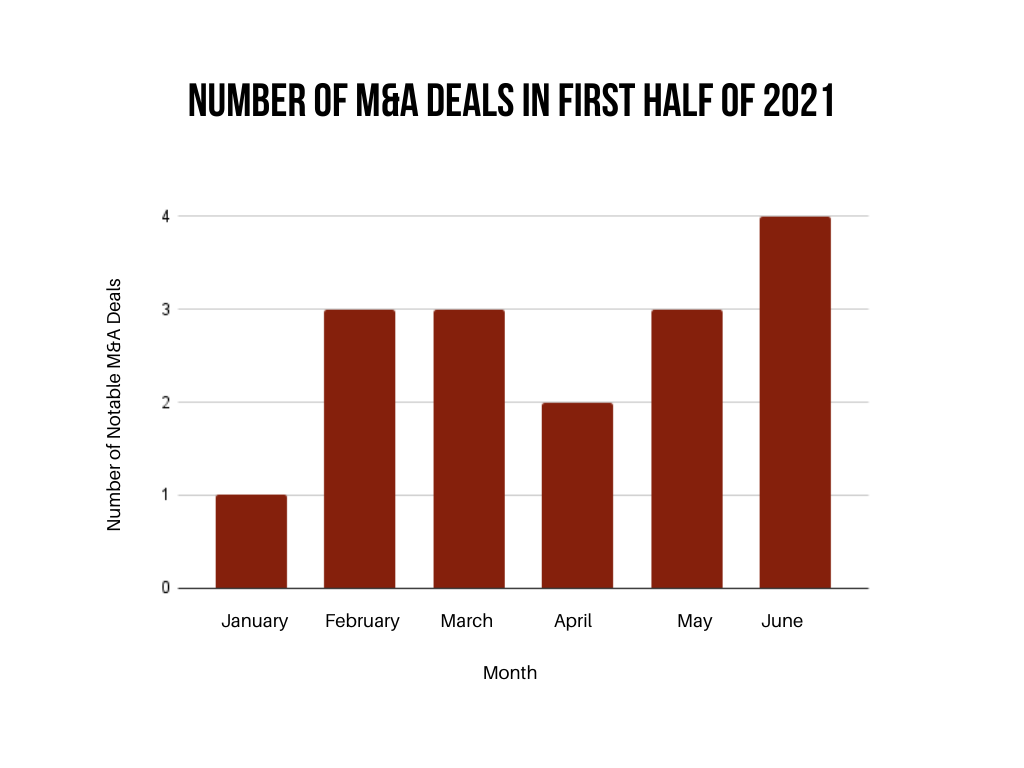
Mergers and acquisitions in the beverage alcohol category were steady in the first half of 2021, but represented a slowdown compared to the first half of 2020.
There were 16 deals made in H1 2021 compared to 26 in H1 2020. The vast majority of the deals fell in the supplier segment of the industry. There were 9 deals that involved spirits brands, 4 that involved wine brands and no notable acquisitions for a beer brand.
New to the Park Street M&A roundup this year were some notable acquisitions in the e-commerce space. Uber acquired Drizly for $1.1 billion, Southern Glazer’s Wine & Spirits took a stake in ReserveBar, and GoPuff acquired BevMo.
In 2020, Constellation Brands, Diageo and Pernod Ricard were active buyers, each with a handful of deals to close out the year, but in 2021 there was a wide mix of companies represented. Below is a roundup of the most notable beverage alcohol M&A deals in the first half of 2021. To view the M&A roundup from 2020, click here.
E&J Gallo Winery has added another brand in a trending category to its portfolio with the acquisition LIQS. LIQS is an RTD brand founded in 2013 by Michael Glickman and Harley Bauer, who set out to premiumize the shot category with top-shelf spirits and real fruit juice. The founders built the brand with a focus in on-premise, including outdoor venues such as arenas and festivals.
“Consumers want to enjoy their favorite cocktails now more than ever,” says Britt West, Vice President and General Manager for Gallo Spirits. “With premium ingredients and convenient formats, consumers can more easily enjoy their favorite bartender-quality shots and cocktails wherever, whenever they want with LIQS.”
Starting this summer, LIQS Cocktail Shots will be available in 4-packs ($9.99 SRP) of spirit-based flavors and beginning September 1, LIQS Cocktails will be available in 1.5L bottles in Margarita, Strawberry Margarita and Mojito.
LIQS joins Gallo’s growing line of spirits brands and innovative formats, including High Noon Hard Seltzer, New Amsterdam Pink Whitney, Rum Haven, and its other recent acquisition, RumChata.