
How These 6 RTD Brands Entered the U.S. Market

Beyond the three-tier system every beverage alcohol brand must navigate, ready-to-drink brands are entering a category growing faster than almost anywhere else in beverage alcohol, and getting more crowded by the month.

According to IWSR data, the U.S. RTD category is on pace to reach $21 billion in value by 2027. Spirits-based RTDs alone grew 17% to $3.3 billion in 2024 before growing another 14% in 2025.

That growth has pulled a flood of new SKUs onto a shelf space that barely existed as its own category a decade ago. It has also forced new entrants to solve distribution problems that don’t map neatly onto the wine and spirits networks most brands expect to use, since RTDs often move in higher volumes and thinner per-case margins that suit beer distribution more than traditional spirits distribution.

The six brands below arrived at that shelf from very different starting points: a former high school teacher who taught herself federal permitting from scratch, a 15-year distribution veteran launching two brands at once, and two friends with no industry background who built a mission-driven brand selling RTD beverages with a 5% revenue donation.

Each found its own way to solve for capacity, distribution, and differentiation in a category defined by explosive growth and constant new competition.

Park Street Imports is the back-office and importing solution for alcoholic beverage brands entering the U.S. market.

BuzzBallz: Turning Distinctive Packaging Into Vertical Integration and Scale

From Classroom to Container Manufacturing

BuzzBallz founder and CEO Marilee Kick entered the beverage alcohol industry in 2010 after leaving a career as a high school teacher, with no prior experience in spirits and no professional network to lean on.

She has said she learned the regulatory process largely by using Google and working through the TTB’s Beverage Alcohol Manual on her own. She secured her federal basic permit along with separate distillery and winery permits within a single six-month window, among the fastest such approvals at the time.

The brand’s spherical, see-through plastic packaging became both its signature and an early operational headache. Unable to get major manufacturers interested without committing to volumes she couldn’t afford, Kick sourced a supplier through Alibaba to produce the container while protecting her intellectual property.

When that supplier began raising prices and couldn’t keep pace with demand, Kick and her team traveled to China to study the manufacturing process. They then built their own machinery to bring production in-house, a costlier path she has said she doesn’t regret.

Breaking Through With Distributors and Scaling Up

Early distribution was rocky. When BuzzBallz launched in California, a room of roughly 100 sales reps at the distributor sold only 38 cases in six months. Then Kick promoted an employee originally hired as a receptionist into a sales role, and she sold roughly 300 cases in her first week.

A 2012 appearance at the Wine and Spirits Wholesalers of America (WSWA) convention brought 15 new state distributors virtually overnight and a double gold medal for its Tequila Rita.

Kick has also credited hiring Blair Casey, previously with distributor Southern Glazer’s and the first person to buy a BuzzBallz product in Texas. His 25 years of distributor relationships gave the brand a network she couldn’t have built alone.

BuzzBallz has continued investing in vertical integration, controlling its own container manufacturing, filling, packaging and marketing even while working through third-party distributors. In 2024, Kick said the company invested $48 million in a production facility expansion intended to double manufacturing capacity, after running distributors out of stock had let competitors fill the resulting shelf space.

The brand leans on convenience stores and other off-premise, single-serve occasions rather than the on-premise. Today it employs around 1,000 people and sells in all 50 states and 27 countries.

It is beginning to expand into Western Europe and, longer term, the Middle East, using bonded warehouses abroad to manage inventory.

Surfside: Riding a Vodka Soda Pivot Into the Fastest Growth Curve in RTD

From Family Juice Business to a COVID Pivot

Surfside CEO Clement Pappas came to the beverage industry after 15 years at his family’s juice company, Clement Pappas & Co., which had evolved from a regional fruit and vegetable cannery started by his grandfather. He ran the business as a subsidiary for about two years following its 2012 sale, staying on until 2014 before his non-compete cleared.

He co-founded Stateside Vodka in Philadelphia with Matt and Brian Quigley after Pennsylvania loosened its distillery licensing laws. The bet was that a well-made vodka could win a local following even as bourbon and cocktail culture dominated the conversation.

The company got its first bottle off the still at the end of 2015 and built Stateside primarily across Pennsylvania, New Jersey and Delaware.

COVID-19 forced an early pivot. Pappas has said roughly 88% of the company’s revenue sources, including Pennsylvania’s state-run liquor stores and all on-premise business, closed almost overnight.

The team responded by launching direct-to-consumer delivery under the state’s self-distribution privileges. They used a Facebook post to generate demand and pulled salespeople and tasting-room staff into vehicles to sell directly to homebound consumers.

That effort brought in about $1 million over two months, funded a still upgrade, and left the company with a base of loyal new customers who stuck around after lockdowns ended.

Launching Surfside and Finding the Right Distribution Fit

That extra capital gave Matt and Brian Quigley room to pursue a ready-to-drink line Pappas had previously resisted. They launched a vodka soda in summer 2021 that sold out immediately.

Surfside itself, a canned iced tea with a retro surf-inspired can design, followed in summer 2022. It was kept deliberately separate from the Stateside name, with the connection noted only on the back of the can.

Surfside sold about 200,000 cases in its 2022 launch year, grew to roughly 1.3 million cases in 2023, and was on pace for four to five million cases in 2024. That run rate reflects close to 600% growth between 2022 and 2023.

Distribution evolved by trial and error. Finding wine and spirits wholesalers unequipped for RTD volume and margins, Surfside shifted toward beer distributors, whose cold-box and pallet-based operations were a better fit.

On-premise sales account for over 30% of volume, which Pappas attributes partly to the product’s 4.5% ABV, positioning it as a beer alternative.

As of the interview, Surfside was live in 44 states. It had grown from roughly 15 to 20 employees to 148 full-time and 243 full-time-equivalent staff, with two dedicated recruiters.

A 2024 Pennsylvania law change permitting RTD sales in grocery stores opened a new channel. Pappas projected the state’s volume of more than one million cases annually could easily double.

On The Rocks Cocktails: Building an Airline-First Channel That Led to a Beam Suntory Acquisition

Taking Restaurant Cocktails to 30,000 Feet

On The Rocks Cocktails began as a side project of a Dallas restaurant group co-founded by Patrick Halbert and Rocco Milano. Their beverage programs had earned a reputation as the best place in the city to get a cocktail, according to the Dallas Morning News.

Patrons working in airline in-flight beverage service, including staff from Virgin America and LSG Sky Chefs, suggested the cocktails would work well on flights. Halbert sold his restaurant interests to pursue bottled, ready-to-serve cocktails full time, working with a contract manufacturer rather than building his own distillery.

The Virgin America relationship fell through when Alaska Airlines acquired the carrier and discontinued its beverage program mid-onboarding. Halbert and Milano regrouped and secured Hawaiian Airlines as their first live account, launching with a Cruzan rum-based Mai Tai and a second custom cocktail.

Halbert has said the brand sold close to 400,000 Mai Tais through that single relationship in a year.

To solve for shelf stability without spoilage, the founders consulted Dave Wingerhoff, a food scientist who had spent 15 to 20 years in food science and development at Diageo. They landed on a 20% ABV formulation that carried no microbiological spoilage risk and could be stored at room temperature, frozen or chilled.

Rebranding, Retail Growth and the Path to Acquisition

Branding needed a mid-course correction. The product launched as OTR, but consumers didn’t understand they needed to pour it over ice, so the team renamed it On The Rocks to make that step explicit.

Outside the airline channel, distribution was built manually. Halbert and Milano cold-called hotel front desks off Google and Travelocity listings to land accounts at the Ritz-Carlton and Four Seasons before any distributor carried their inventory.

By 2019, an 18-SKU lineup across six flavors and three package sizes drove 500% growth. That pushed the brand to roughly 9,000 retail accounts by 2020, including Target, CVS, Kroger and Whole Foods.

The path to acquisition ran through Halbert’s business partner Steve Owsley. His existing relationships with Beam Suntory, built through programs with the Dallas Cowboys and Legends Hospitality at Texas Stadium, led to an initial brand license agreement and small joint venture rather than an outright sale.

Halbert deliberately aligned On The Rocks’ state-by-state distributor selections with Beam Suntory’s existing network, choosing partners like Southern Glazer’s or Republic to minimize disruption in the event of a larger deal.

Beam Suntory, which had previously acquired Skinny Girl and has stated ambitions to become the largest RTD company in the U.S., ultimately acquired the entire brand in a deal that closed in 2020. Halbert has described the process as a handshake agreement reached in under five years from founding.

SipMargs and Su Casa Mezcal: A 15-Year Distribution Veteran’s Deliberate, Market-by-Market Build

Building SipMargs With an “Own and Move On” Strategy

Joey Angelo spent 15 years on the distribution side at Empire, one of the largest wine and spirits wholesalers in the country. Before that, he worked as a bartender and co-owned a tiki-themed bar with a friend. He has said evaluating thousands of brands passing through Empire’s portfolio taught him what not to do.

Angelo left a role at Viva 32 Tequila to launch SipMargs in the middle of COVID-19 lockdowns. He spotted a gap between watered-down tequila sodas and heavily sugared, cocktail-strength canned margaritas like Cutwater.

SipMargs became a sparkling, lower-sugar margarita positioned between those two poles. Development began around August 2020, and the brand launched on Cinco de Mayo of 2021.

Early distribution was difficult because established wholesalers, including Southern Glazer’s and Breakthru, weren’t yet structured for RTD margins or truck-space economics. Angelo has said a case of his product generated far less margin than premium spirits brands like Casamigos or Tito’s.

As volume grew, he shifted more distribution to beer wholesalers already equipped for cold-chain, high-volume products. He also pursued a deliberate “own and move on” strategy, dominating markets like New York, New Jersey and Florida before entering new territory. He cited California’s several hundred BevMo locations as a specific green light for entering that state.

In early 2025, SipMargs completed a full rebrand with new packaging and a $3 million investment from Palm Tree Crew. Angelo has said the deal brought both capital and access to talent and infrastructure the brand couldn’t previously afford.

By late 2025, SipMargs was approaching 60,000 cases annually and expanding from roughly 10 to 11 states into every major U.S. market within 60 days.

Su Casa Mezcal: A Cocktail-List-Only Brand

Angelo also launched Su Casa Mezcal in 2023 as a cocktail-list-only brand, sold exclusively in full-case increments to avoid loose bottle placements on back bars.

He has said the brand averages close to five cases, or 30 bottles, per account per month specifically because those accounts feature it on a cocktail list.

The bottle uses a raised, grip-friendly texture for bartenders working with wet, icy hands. Its bright blue color scheme stands apart from the darker, skull-and-day-of-the-dead aesthetic common among mezcal brands.

Su Casa retails around $25 and leans on a more approachable, agave-forward recipe than a traditional smoke-forward profile.

Crafthouse Cocktails: Staying Independent by Replicating the Bar Experience in a Can

Bringing Bar-Quality Cocktails Home

Crafthouse Cocktails was founded by Charles Joly and Matt Lindner, two hospitality industry veterans who had worked together since 2000. Lindner had opened his own Chicago bar, Bird’s Nest, at age 23. Joly developed concepts including the agave-focused lounge Salud and the craft cocktail bar The Drawing Room, which opened in 2007.

The idea for Crafthouse originated in 2011 after Joly received a late-night call from a guest struggling to recreate an aviation cocktail at home from a recipe the bar had written down for her. The call convinced the founders there was demand for bar-quality ready-to-drink cocktails that people could take home.

The company built its product around a strict rule: use the same spirits, fresh citrus and simple syrup the founders would use behind their own bar. That meant no flavored malt bases, grain neutral spirits or preservatives common among competitors.

The only concession to shelf stability is pasteurized citrus paired with a higher-than-typical ABV. Because no domestic bottler in 2011 could handle fresh ginger, lime and pineapple juice at scale, the founders worked with a small Canadian facility that had previously bottled hard ciders.

Early flavors included the Moscow Mule, South Side and Paloma. The first and last remain the brand’s top two sellers by volume.

Retail, Travel Partnerships and Independent Growth

Getting into Whole Foods was an early milestone, won by approaching in-store buyers directly despite the chain’s once-a-year reset cycle and initial disinterest in the category.

A bigger one came roughly two years after launch with a placement on United Airlines, which at its peak represented as much as 65% of Crafthouse’s business. It led to further placements on Amtrak’s Acela line, a Marriott pilot program, and status as the only RTD cocktail brand aboard Virgin Voyages’ cruise ships.

About two years before the interview, the company redesigned its 200-milliliter format from a four-pack glass bottle to an individual-serve aluminum can. The change was driven partly by airline weight and breakage concerns and partly by Virgin’s push for recyclable materials.

As of the interview, Crafthouse operated as a 10-person company offering eight pre-mixed cocktails across three formats, including a 1.75-liter bag-in-box. It was nearing distribution in 40 states while remaining fully independent, without outside acquisition or major investment.

To extend its marketing reach without growing headcount, the company signed a partnership with Dolphin Entertainment, whose PR division the founders said had worked informally with Crafthouse since its early years. They framed the deal as a way to build broader recognition rather than a step toward being acquired.

Mission Cocktails: Building a Mission-Driven Brand From Zero Industry Knowledge

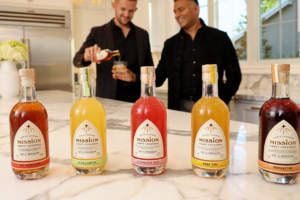
Two Neighbors, Real Ingredients and a 5% Revenue Pledge

Mission Cocktails co-founders Amit Singh and Marcin Malyszko met at a charity event in their California neighborhood. They became close friends after discovering they lived a block apart, despite a 20-year age gap.

When COVID-19 closed bars, the two tried recreating cocktails at home, then sampled 60 to 70 ready-to-drink products and found none that matched a freshly shaken drink.

Neither had a background in spirits procurement, bottling, distribution or licensing. By their own account, they researched the basics by searching terms like “what factory makes alcohol.”

The founders set two non-negotiable standards: real, California-sourced ingredients rather than flavor-house concentrates, and a commitment to donate 5% of all revenue, not just profit, to local food banks.

Distilleries told them fresh lime juice couldn’t work at commercial scale and pushed them toward flavor houses. Singh and Malyszko spent two and a half years finding partners willing to use real juice, including six fresh limes per bottle of their Margarita and a handmade orange liqueur for their Cadillac variation.

Their first production run totaled just 600 bottles. To validate quality, they entered the San Francisco International Wine and Spirits Competition and won double gold.

Scaling Distribution With Park Street

Early distribution was self-directed. After cold-calling grocery chain executives directly, the founders realized they needed a formal distributor and built momentum through in-store tastings, with Malyszko personally guaranteeing he’d buy back unsold inventory.

Park Street was brought on to handle back-office operations, which let the founders expand into territories like Ventura and West Hollywood beyond what they could service with a single delivery van. That helped land placements at Total Wine and BevMo.

Park Street has continued supporting warehousing and compliance as the brand scaled into a partnership with Reyes Holdings, the largest beer distributor in North America and a partner of Tito’s Handmade Vodka. The founders describe the approach as being able to “grow up with Park Street” rather than outgrow it.

Nielsen data placed Mission Cocktails fifth among RTD cocktails in the 375-milliliter format in California in 2024, despite entering major chains like Whole Foods, Gelson’s and Pavilions only in the fourth quarter of that year. The brand expanded nationally with Total Wine & More across more than 240 locations in May 2025.

On-premise placements followed organically, including a Hyatt in Orange County where Mission’s Margarita and Mai Tai became the top-selling, most profitable item on its pool menu, and Ritz-Carlton events with 300 to 500 attendees.

Two years after launch, the company has funded more than 100,000 meals through its revenue-donation model.

What These 6 Brands Have in Common

Building Demand and Distribution on Their Own Terms

Each of these brands built early demand by hand before a distributor did any of that work.

Marilee Kick promoted a receptionist to sales rep to turn around a California market where a room of 100 distributor reps had sold only 38 cases in six months. Patrick Halbert and Rocco Milano built a target account list by Googling hotel names and cold-calling front desks before any distributor stocked their product. Amit Singh and Marcin Malyszko cold-called grocery chain executives directly and personally guaranteed to buy back unsold inventory from independent liquor stores.

Joey Angelo took a related but distinct approach with SipMargs. He deliberately capped expansion to markets like New York, New Jersey, and Florida where the brand could dominate before opening new territory, rather than spreading a small team thin chasing every available account.

These brands also had to work around a wine-and-spirits distribution system not built for RTD volume and margin profiles, and several found beer distributors a better structural fit.

Surfside shifted much of its distribution to beer wholesalers after finding that wine and spirits houses lacked the cold-box space and margin tolerance for its volume. SipMargs made the same move once it recognized beer distributors already had the infrastructure that Southern Glazer’s and Breakthru did not. Mission Cocktails built toward a partnership with Reyes Holdings, the largest beer distributor in North America, after proving its retail performance through Total Wine and BevMo.

BuzzBallz sidestepped the issue differently, producing malt-based, wine-based, and spirit-based versions of the same product so it could work across whichever distributor type was available in a given state.

Anchoring to One Defensible Product Decision

Finally, each brand anchored itself to one specific, defensible product or packaging decision before trying to scale, rather than launching a generic entry into an increasingly crowded category.

BuzzBallz built its business around a spherical, see-through container unlike anything else on the shelf. On The Rocks solved for shelf stability with a 20% ABV formulation and renamed itself specifically to teach consumers they needed to pour it over ice.

Crafthouse refused to substitute fresh citrus and branded spirits for flavored malt bases or grain neutral spirits, even when it meant sourcing a bottler in Canada. Mission Cocktails applied the same discipline to ingredients, insisting on real, California-sourced juice over flavor-house concentrates even when producers told them it could not be done at scale.
Request a Consultation with Park Street

Mom Water

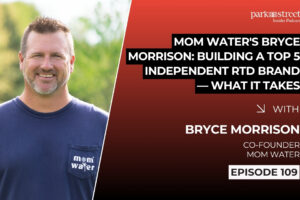
Mom Water’s Bryce Morrison: Building a Top 5 Independent RTD Brand— What It Takes

When Bryce and Jill Morrison started diluting flavored vodka into an old Dasani bottle so Jill could stop feeling bloated and hungover after a day in the sun, they weren’t trying to build a brand. Neither of them had ever worked in alcohol: both of them worked in the medical industry. What started as a homemade fix for their pool days in southern Indiana became Mom Water, the first non-carbonated, unsweetened vodka water on the market, and today one of the top 5 independent RTD brands in the country, still family-owned and funded off a line of credit rather than outside investment, sold in tens of thousands of retail locations nationwide.

In this episode, co-founder Bryce Morrison joins the Park Street Insider to talk about building a national alcohol brand with zero industry experience — learning distribution, co-packing, and federal excise tax as he went. He shares why leaning into an unapologetically mom-centric identity, rather than chasing a broader audience, became Mom Water’s biggest growth engine; how the brand scaled almost entirely on word-of-mouth and organic social content instead of paid marketing; and what it took to hand the CEO role to his sister, Kara, while staying independent and keeping the family-run culture that built the company intact.

Park Street Imports is the back-office and importing solution for alcoholic beverage brands launching and scaling in the U.S. market.

Featured Guests:

Bryce Morrison, Co-Founder, Mom Water

Mentioned in the Episode:

Mom Water

Want to stay in the know about new episodes from the podcast? Click the link here.

Learn More About Park Street

Sign up for our Daily Industry Newsletter.
Sign Up for our
Monthly Newsletter.

Check out Park Street’s Guide to Getting Started in the U.S. Market

Follow us for more industry insights on

Photo of Oli Dodd

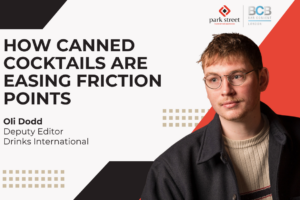
2026 Alcohol Trends: Why RTDs Are Winning the Next Generation

Oli Dodd, Deputy Editor at Drinks International, delivers a highly analytical presentation on current alcohol trends at Bar Convent London, navigating the modern beverage alcohol market by solving consumer “friction points.” We dive deep into the evolution of the RTD category as a case study in friction-solving. Discover how the category matured from the portable, low-calorie hard seltzers of 2019 to the modern wave of high-quality, premium canned cocktails.

Park Street Imports is the back-office and importing solution for alcoholic beverage brands launching and scaling in the U.S. market.

Oli Dodd’s Presentation Transcript

Oli Dodd (00:03) I’m going to be looking a little bit into how I’m approaching this subject matter, but from my perspective as a journalist rather than a brand owner or an analyst. I tend to look at things in a slightly more trend-based way. I spend a lot of my time thinking about how consumers are driven, how micro and macro trends form, and how that is shaping where we are now. To start off, I’d just like to look at a couple of graphs.

Oli Dodd (00:33) These are very broad. This is IWSR data, and it shows global volumes of alcohol intake—this is volume, by the way, not value—from 2015 to 2025, the most recent data we have. I want to split this into three separate phases. First, we have this pre-pandemic slight decline; then, a big event here in the middle; and finally, a small recovery followed by some subsequent declines.

Oli Dodd (01:04) It is really interesting to think about this from our 2026 mindset. If we were to very lazily place a straight trend line across all of these data points, it would pretty nicely match up. But we know something very big happened in the middle, and everything on the right side of the graph is completely influenced by that disruption.

Oli Dodd (01:33) The pandemic was a huge accelerator of trends. We had social trends accelerating; people became much more focused on health after being suddenly confronted with the vulnerability of their well-being. We also experienced financial and supply-chain disruptions that we are still not fully over.

On top of that, we faced market-by-market issues that weren’t pandemic-related but remain highly relevant: Brexit, regional wars, and a wave of new tariffs all over the globe. All of these factors shade this part of the graph to look the way it does. Yet, the fact that we can still draw a loosely fitting trend line across the whole timeline indicates that there is a longer-term macroeconomic force at play.

Oli Dodd (02:31) If we look specifically at the UK data, it shows those shifts even more clearly. From 2015 to 2019, we see a more severe decline, followed by a sharper pandemic drop. However, we also see a greater recovery and a less severe subsequent decline on the other side of it. This shows that while the UK is largely operating in tandem with global trends, it perfectly fits the model of picking up right where it left off in terms of how moderation is influencing consumer choice. I just want you to bear that baseline context in mind as we look at how those macro events continue to shape the industry landscape.

Oli Dodd (03:00) You can read the text on this next slide if you like, but the one thing I really want to draw your attention to is this specific figure. For the longest time, when we were writing about the industry to try and describe what was driving those early, pre-pandemic declines and the beginning of the post-pandemic recovery, we used a phrase I’m sure you’re all familiar with: “less but better.” This wave of premiumization was coloring absolutely everything. People were consuming less volume, but the financial value of the market remained steady or increased.

Oli Dodd (03:30) If we are to believe this latest set of results, that dynamic might be changing now. Anecdotally, we can kind of feel that shift happening in the trade. It looks like the “less” part of the equation is hanging around, but the “better” bit is starting to struggle.

Oli Dodd (04:00) With that in mind, I’d like to show you one more graph. I’m sorry for all of this statistical data, but this is a particularly horrible chart because it visually makes it look like the no-and-low alcohol sector is three times larger than spirits! That is not what it’s actually showing. What we are mapping here is year-on-year growth rates for these different categories.

As you can see, spirits, beer, and wine—which, for all intents and purposes, constitute beverage alcohol—follow a very similar growth trajectory to what we saw in the previous UK volume graph. However, two specific subcategories show a completely different pattern of growth. In 2020, when traditional beverage alcohol categories took a sharp decline, both of these jumped. (And by the way, when looking at no-and-low alcohol volumes here, we are primarily talking about no-and-low beer; we aren’t really talking about anything else yet.)

Oli Dodd (04:55) Both of these categories took a massive leap forward, which tells us a lot about how to navigate this market. As a case study, ready-to-drink (RTD) products are a great example of this friction: the exact same market pressures that caused traditional categories to decline are what RTDs were able to exploit to achieve explosive growth.

Let’s look at a brief summary of the last few years in the RTD sector. We aren’t talking about old-school alcopops here; that belongs to a previous generation of this category. What we are talking about is everything that emerged around 2019 and 2020, and the story of that era is hard seltzers.

Oli Dodd (05:52) The attributes that hard seltzers offered mapped perfectly onto the consumer friction points brought about by the pandemic. People were suddenly more health-conscious, and here was a category that purported to be better for you—low carb and lower calorie. A lot of people were suddenly less financially flush, and these products were highly affordable. They were also portable at a time when people weren’t drinking in bars; they were convenient, and you could buy them at the local corner shop. All of these macro factors dramatically benefited them as a category.

Oli Dodd (06:22) But the one thing we can’t claim hard seltzers to be—and I’m sorry to everyone in the room who disagrees—is premium. Generally speaking, they don’t even name the specific alcohol that is in them. They are bought from a corner shop right next to a can of Coke. They possess inherent category limitations that they can’t easily fix.

Because of that, as the RTD category matured, premium canned cocktails stepped into the space. Brands like White Box and Moth solved the exact problems hard seltzers couldn’t. They are genuinely premium, they use named spirits, and while they are a little bit more expensive, they remain accessible. They delivered what hard seltzers couldn’t, and what other traditional categories weren’t providing.

Oli Dodd (06:51) This next statistic is really interesting: IWSR data shows that 43% of UK Gen Z respondents said they had consumed an RTD can within the previous six months. That is significantly higher than the UK population at large, where penetration is only about a quarter of consumers.

For a very long time, the industry narrative was that Gen Z simply didn’t drink. While there is still some truth to their overall moderation, they are now coming back online in comparison with other demographic cohorts. What this data tells us is that for a generation that came of age during the pandemic, they felt those lifestyle friction points much more acutely.

Oli Dodd (07:51) The moment a category emerged that was able to appeal to them and solve for those specific friction points, it reached them in a way that traditional spirits categories couldn’t. We are seeing that play out now with the wild success of brands like BuzzBalls—which is somewhat head-scratching to older generations but makes total sense to a younger consumer.

Naturally, this shift hasn’t gone unnoticed by major players like Diageo. If I were an independent RTD brand right now, I think I would feel two ways about their entry into the space. On one hand, there is certainly some fear; it’s like you’re a League Two football team and suddenly Arsenal joins your division. That’s frightening. They have unmatched commercial reach and unmatched scale. On the other hand, their entry validates the category and proves there is an immense amount of long-term commercial potential here.

Oli Dodd (08:20) This begs the question: where exactly is that growth potential? For RTDs, convenience is their native language, so they make total sense as an off-trade retail item. But I’ve been hearing it for a long time now: it is the on-trade where Diageo has its sights set. They want to insert these premium canned cocktails into bars and restaurants as standard serves.

To evaluate that, we have to think about what people actually want when they enter a hospitality venue. Consumers and bar guests generally want a few core things: they want to feel looked after, they want to drink something tasty, and they want to feel like they are experiencing good value—whatever that word means to them.

Oli Dodd (09:17) Premium canned RTDs solve the first two requirements quite easily. As long as you serve a brand the consumer trusts, they are consistent and tasty. From an operational standpoint, the speed of service is unmatched. It’s similar to the Blank Street Coffee model: you don’t necessarily need a highly trained bartender who knows how to manually build every complex drink from scratch. You can just open a premium can, allowing the staff to spend the rest of their time hosting and looking after their guests.

However, that third point—value perception—is where the real challenge lies. There is something about watching a cocktail manually crafted right in front of you that feels inherently more premium and valuable than watching someone pour liquid out of a can.

Oli Dodd (10:10) Just this past Friday, I was having a drink with someone who used to own an RTD brand but exited the business. The primary reason they gave was that they simply couldn’t get the liquid format to work financially in the on-trade. So, this is clearly a major sticking point for the category.

On the flip side, you have iconic bars like Tayer + Elementary in Old Street, which I’m sure many of you are familiar with. They have been absolutely evangelical about the use of pre-batched and RTD serves. They use them continuously, and they are regularly ranked among the very best bars in the world.

So, the on-trade is not a monolith. If you can design a bar program where the speed of service and the liquid consistency outweigh the theater of a bespoke build, it can absolutely work in a high-end environment.

Oli Dodd (10:38) I am running out of time, so I will wrap things up. Am I saying that we should all rush out and launch RTD brands? No, of course I’m not. But what I am saying is that if you view the market through this lens—as a complex patchwork of micro-trends and distinct consumer cohorts—and you can pinpoint exactly where your target audience’s friction points are and design a product to solve them, there is still plenty of room for commercial growth, even in a downturned market.

Thanks a lot, everyone. That is my time.

Make sure to hit the subscribe button to keep up with the latest beverage alcohol industry insights from Park Street University.

news-icon

RTDs (Ready To Drink) Suppliers

RTD Product Launch & Growth SolutionsCompliance, Importing, Distribution, RTD Beverage Services & Reporting Connect With Us Ready-To-Drink Beverage Services RTD Beverage Services Park Street gives RTD suppliers the infrastructure to manage a category defined by...
Mission Cocktails

How Mission Cocktails Built a Purpose-Driven RTD Brand Without Industry Experience

This case study examines how Mission Cocktails co-founders Amit Singh and Marcin Malyszko built a premium ready-to-drink cocktail brand from scratch with no prior industry experience by combining real ingredients, hard work, and a commitment to donating 5% of all revenues to local food banks.

From Dog Walks to Mission Partners

Mission Cocktails began with an unlikely friendship. Amit Singh and Marcin Malyszko met at a charity event in their California neighborhood, but didn’t actually introduce themselves. A week later, Malyszko spotted Singh and struck up a conversation, discovering they lived a block apart.

“Despite a 20-year age gap, we became best friends very early on,” Malyszko explained. “Humble upbringings, values, morals, character, passions, vision—everything about how we operated as individuals just related on so many levels.”

Their friendship deepened over dog walks with cocktails in hand, frequent visits to restaurants and speakeasies, and a shared appreciation for quality drinks. When COVID-19 hit and forced bars to close, the two friends attempted to recreate their favorite cocktails at home using YouTube recipes.

“Our wives hated all the mess, our drinks sucked, and we were disappointed,” Malyszko recalled. They turned to canned and bottled cocktails instead, ultimately trying 60 to 70 different RTD products during the pandemic.

After sampling expensive bottled cocktails that failed to deliver on quality, the friends had a late-night epiphany: “There have to be other people who want something that tastes like it came out of a shaker, a real cocktail that uses real juice.” 

They decided to build a mission-driven business. Mission Cocktails was founded with a commitment to donate 5% of all revenues (not just profits) to local food banks.

“If it were just a passion project, just something we wanted to do, we wouldn’t have that same passion,” Singh explained. “For us, it’s that give back that kept us going every single day.”

Starting From Zero Industry Knowledge

The co-founders knew nothing about spirits procurement, bottling, distribution models, or licensing. Their first research tool was remarkably simple.

“Before we even knew about Park Street University, we found this amazing feature called Google,” Singh said. “We literally just Googled everything. We didn’t even know the word distillery—we searched ‘what factory makes alcohol?'”

They spent weekends in their kitchens perfecting five cocktail recipes to their personal taste, assuming they could simply hand these recipes to a distillery for commercialization.

When they approached distilleries, the reality check was immediate. Producers told them that what they wanted to do was impossible because commercial production couldn’t use fresh lime juice the way home bartenders do.

“They said, ‘You’ve got to go to a flavor house,'” Singh recalled. “We were Googling in these meetings, ‘What’s a flavor house?'”

Most distilleries insisted they use artificial flavors and concentrates. However, Singh and Malyszko had established two non-negotiable principles: they would never deviate from their 5% revenue donation, and they would only serve drinks they were proud to offer to friends, using real, California-sourced ingredients.

It took two and a half years to find the right partners and develop the right processes. The result was a product line featuring real juice, including six limes in every bottle of their Margarita, and a handmade orange liqueur crafted with California oranges for their Cadillac version.

“If we did know about flavor houses, we’d be making water, food coloring, generic alcohol, and flavor droplets,” Malyszko noted. “We’d be at an entirely different product than we are today.”

Their first production run consisted of just 600 bottles. Friends loved the product, but Singh and Malyszko knew they needed objective validation. They submitted their cocktails to the San Francisco International Wine and Spirits Competition and won double gold.

The industry recognition gave them confidence to take their business seriously. They worked out the bottle economics and realized every bottle sold could fund one meal for families in need. Today, two years after launch, Mission Cocktails has funded over 100,000 meals.

Navigating Distribution Without a Roadmap

Not knowing the industry proved both a challenge and an advantage. Singh and Malyszko initially tried to avoid distributors entirely after reading “horror stories” on LinkedIn about the difficulty of getting attention in large portfolios.

Reality intervened when they began cold-calling CEOs of grocery chains. “They were like, ‘You don’t work with my six distributors, you’re never getting in my stores,'” Malyszko explained. “We realized the business we wanted to be in required a distributor.”

Their DIY approach did create early momentum. They convinced independent liquor stores to allow them to conduct tastings during busy periods. “I personally said I would buy back any inventory that didn’t sell,” Malyszko recalled. “It was just that confidence.” The tastings were successful, creating demand that began to attract the attention of retailers.

Strategic Partnership with Park Street

Park Street became crucial to Mission Cocktails’ growth strategy, providing the operational infrastructure they needed while they focused on sales and product quality.

“Park Street was huge for us,” Singh said. “We went from aggressively looking for a distributor to aggressively not looking for a distributor. Now we had the patience to look and take our time for that next level.”

The platform enabled them to expand their geographic footprint beyond what they could handle with their Sprinter van, opening accounts in Ventura, West Hollywood, and other areas they couldn’t efficiently service on their own.

Their first major retail wins came through this model. They secured placement at Total Wine, followed by BevMo, which started in Orange County and expanded. As Mission Cocktails proved its retail performance, larger distributors took notice. The co-founders deliberately pursued beer distributors rather than traditional spirits wholesalers.

Their spirit-based product naturally belonged in cold boxes, where beer distributors excel. After careful evaluation, they partnered with Reyes Holdings, the largest beer distributor in North America, which had recently partnered with Tito’s Handmade Vodka in the spirits category.

“They really took a chance on us,” Malyszko said. “Being a tiny portfolio addition versus what they carry, but they’ve been fantastic.”

With Park Street continuing to support their warehousing and compliance needs as they scale with Reyes, Mission Cocktails exemplifies how brands can “grow up with Park Street” rather than outgrowing partnerships as they expand. Park Street helps brands maintain operational efficiency while focusing on what they do best: making exceptional cocktails and feeding families in need.

Retail Success and National Expansion

Mission Cocktails’ retail performance has exceeded expectations. Nielsen data for 2024 showed the brand ranking fifth among RTD cocktails in the 375ml format in California, which was particularly impressive given that they only entered major chains like Whole Foods, Gelson’s, and Pavilions in Q4, so the data doesn’t reflect a full 12 months. In May of 2025, Mission Cocktails launched a nationwide expansion with Total Wine & More, spanning over 240 spirits retail locations. 

While Mission Cocktails focused primarily on retail, on-premise opportunities emerged organically. After serving as the exclusive alcohol provider at a charity event, they received their first hotel account.

Additional hotel wins followed. A major Hyatt in Orange County created Margarita and Mai Tai slushies using Mission’s bottles, which became the number-one selling and most profitable item on their pool menu. Ritz-Carlton locations now use the cocktails for special events with 300 to 500 attendees.

Advice for Aspiring Founders

For entrepreneurs considering the beverage alcohol industry, Singh and Malyszko offered hard-earned wisdom:

“If you’re not 1,000% convinced that you want to do this, then don’t do it,” Singh advised. “You will want to quit a thousand times. If you just think this will be cool, you’re not going to have the grit and hustle to see it through.”

Malyszko emphasized resourcefulness: “So many people say they don’t have the funding or knowledge or connections. Google can give you a lot of answers. Go to conferences—people are incredibly helpful. We went to our first trade show with a Photoshop image on a Listerine bottle, which had no liquid yet, and people were kind and offered help.”

Their final piece of advice centered on the importance of mission: “If it were just making a widget, we wouldn’t have that same passion,” Singh reflected. “When you can marry passion and purpose together, amazing things really do happen.”


Request a Consultation with Park Street