*By Maria Pearman, CPA, Advisory Partner & Food and Beverage Practice Leader at GHJ
For many craft distilleries, SKU growth happens gradually. A seasonal release performs well, a limited batch earns attention, a retailer asks for something exclusive, or a founder falls in love with a product that feels important to the brand story. Over time, the portfolio expands. At first, that expansion can look like momentum. But more SKUs do not always mean more profit.
The Benefit of SKU Rationalization
In a market where growth is slower, input costs are higher, and distributor and retailer attention is harder to earn, SKU rationalization has become an essential operating discipline. The question is no longer, “Can we sell this?” The better question is, “Should this product continue to earn space in our portfolio?”
Assessing SKU Profitability
The starting point is true SKU-level profitability. That means looking beyond topline revenue and understanding the real economics of each product. A SKU may generate volume but still drag down the business if it carries a weak gross margin, requires expensive packaging, creates production inefficiencies, ties up too much inventory, or absorbs labor and overhead that are not being properly measured.
The most dangerous mistake is scaling an unprofitable product. When a low-margin SKU grows, the problem grows with it. What looked like success on a sales report can become margin erosion on the income statement and cash pressure on the balance sheet.
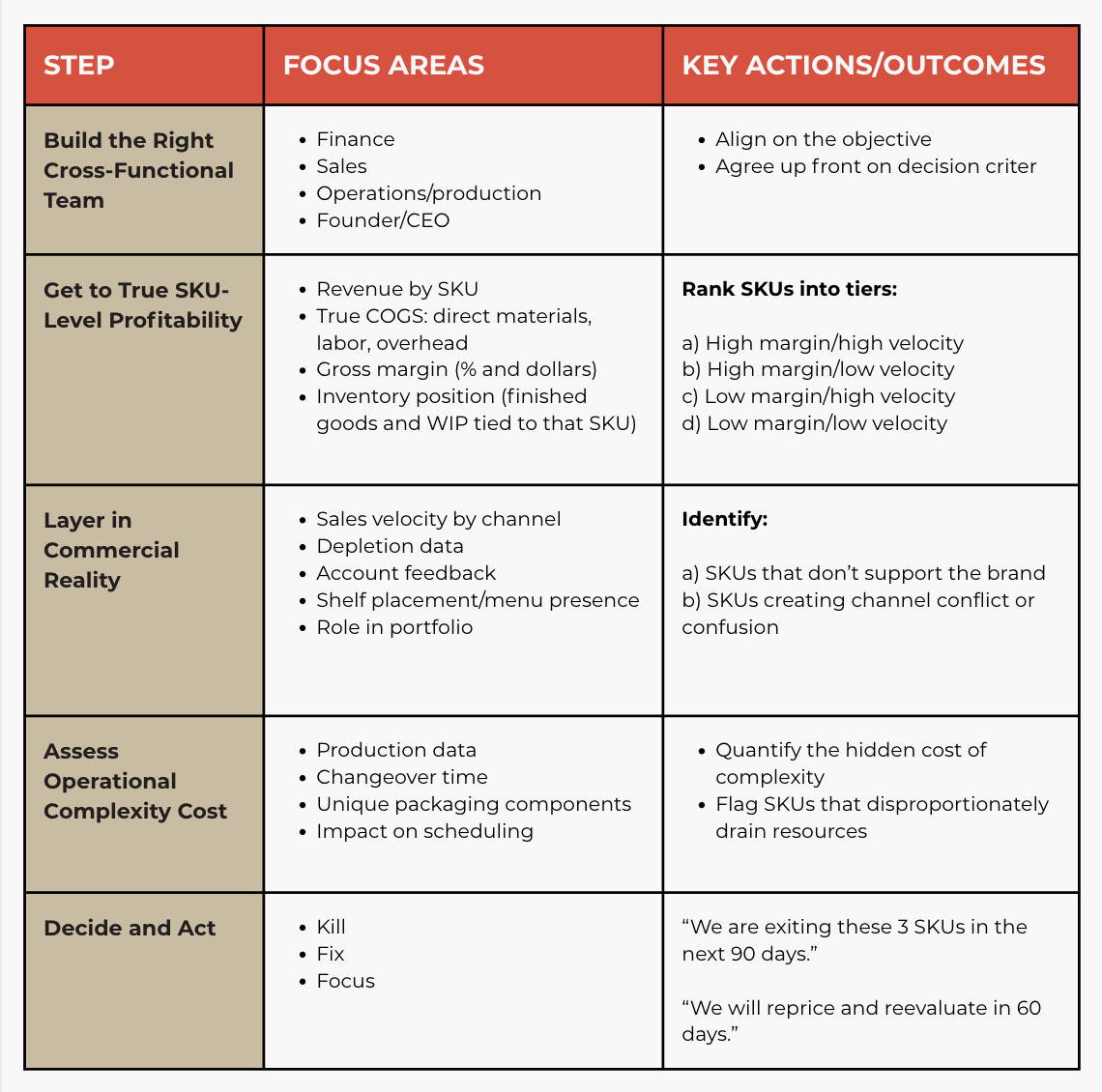
A strong SKU rationalization process should be cross-functional. Finance, sales, operations, production, and leadership all need a voice. Finance brings the numbers. Sales bring channel reality. Operations and production bring visibility into complexity, scheduling, batch yields, changeover time, and hidden costs. Leadership keeps the team aligned on the broader strategy.
The analysis should begin with revenue by SKU, true cost of goods sold, gross margin percentage, gross margin dollars, and inventory position, including finished goods and barrels tied to that product. From there, SKUs can be grouped into practical tiers: high margin/high velocity, high margin/low velocity, low margin/high velocity, and low margin/low velocity.
Commercial Reality Matters
But profitability alone is not the full story. A SKU may play an important role in the portfolio even if it is not the highest-volume item. It may support brand identity, unlock a key account, or perform well in a specific channel. On the other hand, a product may create confusion, channel conflict, or distraction even if it has pockets of demand.
Operational complexity also deserves serious attention. Unique packaging components, long changeover times, production downtime, and scheduling friction all carry costs. These costs are often invisible until the team deliberately quantifies them.
How to Streamline a Portfolio
Once the facts are clear, the decision should be direct: kill, fix, or focus.
Some SKUs should be discontinued. Some should be repriced, reformulated, repackaged, or moved to a different channel. Others deserve more support because they have the right combination of margin, velocity, brand fit, and operational efficiency.
SKU rationalization is not about making the portfolio smaller for its own sake. It is about making the business stronger. The goal is to protect cash, improve gross margin, reduce complexity, and focus resources on the products that can actually help the distillery grow.
Great operators do not let every SKU survive on sentiment. They make each product prove its role in the business.
SKU Rationalization Chart