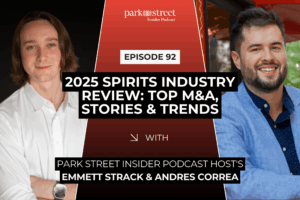
2025 Spirits Industry Review: Top M&A, Stories & Trends
In 2025, the beverage alcohol sector saw significant evolution across its regulatory, distribution, and investment landscapes. In this comprehensive Year in Review, Park Street Insider hosts Emmett Strack and Andres Correa sit down to analyze the year’s defining moments through three key lenses: top industry news, emerging market trends, and major M&A activity.
In this episode, we review the headlines that mattered most, including the implications of RNDC’s exit from California, the shifting tariff environment, and notable CEO turnover among major suppliers. We also examine broader structural changes, from the complexities of the THC bill to the increasing migration of suppliers toward beer distributors, and break down the year’s investment climate, highlighted by AB InBev’s acquisition of Beatbox. We’ll explore the practical takeaways from these developments and discuss how they set the stage for the industry in 2026.
Mentioned in this episode:
Navigating Beverage Alcohol Tariffs: Short-Term Tactics & Long-Term Strategies
How Nosotros Tequila & Mezcal Navigated the RNDC CA Disruption and Returned to Growth
Beverage Alcohol Tariffs in 2025: Latest Developments & Industry Response
Want to stay in the know about new episodes from the podcast? Fill out the form below: https://share.hsforms.com/1MEb-81x2TXi3f15qO_yEpA4tip1
Learn More About Park Street
Sign up for our Daily Industry Newsletter.
Sign Up for our Monthly Newsletter.
Check out Park Street’s Guide to Getting Started in the U.S. Market
Follow us for more industry insights on
Podcast Transcript
Emmett Strack (00:02.062)All right, so we are going to be recapping the year in spirits for 2025. I am joined by my co-host on the Park Street Insider podcast—a rare moment when we both get to share the mic—the fabulous Andres Correa.
Andres Correa (00:20.000)Andres, how are you doing today? Emmett, I’m doing really great. I think when you look back at 2025, it’s one of the more unique years since I’ve been in the business. It really called for us to get on the mic together and recap everything.
Emmett Strack (00:35.000)I totally agree. I think there’s a little bit of a “more things change, the more they stay the same” vibe about 2025. I think as opposed to the past couple of years, suppliers have more concrete reasons to be optimistic going forward. So, Andres and I are going to recap the year in spirits and the wider industry. We are going to structure this by starting off with some of our top stories from 2025.
After taking you through those, we are then going to hit on the top M&A deals of the year and give you our thoughts and reflections on what went down in that sector. And then finally, we’re going to get into some of the major trends that dominated the year. All right, Andres, what is your top news story of 2025?
Andres Correa (01:10.000)You know, Emmett, you made a great point. I think as the year started off, it was really, really rocky. I do think by the time we get to talking more about stuff that happened towards the end of the year, there is a lot to be optimistic about, but it’s hard to deny that the top story of 2025 was tariffs, unfortunately.
I think we all expected some tariff movement under this administration—especially those of us who covered the first administration—but the level of unpredictability managed to exceed expectations this time. Very early on in the year, there were tariffs on two key trade partners, Mexico and Canada, as well as China. Those were aimed at creating some negotiating leverage with border issues like fentanyl smuggling.
But then came “Liberation Day” in April, when we all saw that famous chart with all of the really high tariff rates. I believe the stock market dropped about 20%, depending on the index you were following at the time. It was somewhat surreal.
Emmett Strack (02:14.99)Yeah, it was one of those things that I think will always be imprinted on the brain. It was very visual and shocking. I know you and I were chatting at the time it happened, just trying to keep up with it and deliver the proper information to our newsletter readers. From there, there was basically a major negotiation with every country around the world over the summer.
My biggest takeaway from all of that is just how resilient the industry is and how quickly a lot of brands and importers were able to adjust and become well-versed in all these mitigation strategies—whether it was first-cost law, the proper use of FTZ, or even just shifting and renegotiating sourcing. Earlier this year, we had Allison Levitt of WSSA on the podcast twice, and she was able to discuss the tactics that she saw working. On the Park Street University YouTube channel, we had a 20-minute feature from Maria Pearman where she dove into everything including duty drawbacks, smart contracts, and much more. But I think something really important that we also saw this year was lobbying efforts like “Toasts Not Tariffs,” right?
Andres Correa (03:30.000)Yeah, and on “Toasts Not Tariffs,” I think that kind of action shows that when the industry comes together, it can really affect change. We landed on those agreements with the EU and UK as a result of coordinated advocacy, and this should be a template for the industry going forward as we continue to face turbulence in this way. The spirits industry has bipartisan appeal; it creates jobs across many different demographics and, crucially, it supports the hospitality industry. That’s a powerful story. In 2025, we proved that if we tell that story effectively when the stakes are high enough, we can really affect change. So we need to keep doing that.
Emmett Strack (04:10.000)Yeah, you mentioned those key agreements with major partners like the EU and UK, and I think that is something to be very positive about moving forward. I think the biggest negative impact we’ve seen on the beverage alcohol side is just with the consumer population in Canada and how they’ve reacted toward American products. That’s something you can’t really fix so easily just by changing a tariff rate; that’s a relationship thing.
Emmett Strack (04:32.374)Going into next year, I do think there should be some level of optimism on how this outlook develops. From a baseline, we do have those key agreements with major trading partners in place, so there seems to be at least a little less uncertainty around that. There is even some hope that rates on alcohol specifically could go down further with partners like the EU.
But then there’s also the fact that the Supreme Court is reviewing tariff policy to see if President Trump overstepped his powers with the reciprocal tariffs. So, there’s a possibility we’ll even see some refunds if that gets overturned, potentially in the summer. Although, I do think the whole refund process would be very messy and potentially years long, so it’s not quite so simple. But just the concept of refunds might be something optimistic to look forward to for some people.
Obviously, this was a really big theme of the year, and I think your optimism about 2026 is important. It’s warranted, and it’s been really interesting to see the industry go through an accelerated learning curve in terms of global trade complexity. Five years ago, things you were throwing out earlier—like first-cost law and FTZ strategies—were things typically only mentioned by specialists, and now they’re regular conversations at distributor meetings. I think there’s something remarkable about watching the industry collectively upskill under pressure like that. There is an element of learned adaptability that we all went through this year.
Even if this environment remains somewhat uncertain going forward, suppliers are now in a better position to deal with that uncertainty. I, of course, still wonder if this is just going to be a “new normal” over the next couple of years where tariff stability is somewhat provisional. It’s going to be important for brands to maintain those mitigation strategies and consider them as permanent ways of operating rather than just emergency measures.
Andres Correa (06:30.000)Yeah, and I think that’s what’s good about some of the mitigation strategies we learned this year. Specifically, I think Maria Pearman’s video did a good job of breaking down the short-term strategies to deal with the short-term uncertainty, as well as the long-term strategies in terms of changing sourcing to shelter yourself from tariff uncertainty in the future.
Emmett Strack (06:51.608)I think there is reason to be optimistic about some stability moving forward after the whirlwind we experienced in the summer. Definitely. And like you mentioned, we have a ton of resources on Park Street University for getting more familiar with mitigation strategies and ways to adapt. Anyone can feel free to go check those out. So, that’s my top story of the year. But Emmett, I know you’ve got a big one as well for story number two.
Emmett Strack (07:30.000) Yeah, I sure do. For my top story, I’m pulling off the board RNDC’s California exit. Taking you to the distribution tier, we saw in early June the nation’s second-largest distributor completely pack up their bags and exit the number one spirits market by volume in the country: California. This was a pretty unprecedented collapse for a major distributor, and the implications were massive. It cut about 1,700 jobs and left about 1,500 suppliers scrambling to find distribution solutions, serving as a keen reminder of how fragile distribution relationships can be.
How did we get here? This came as a result of a number of devastating brand departures throughout 2025. In January, Tito’s Vodka announced it would move distribution from RNDC to Reyes Beverage Group. Then in February, Brown-Forman said it would do the same. In April, Gallo revealed that it would be moving the top spirits brand by volume in the U.S., High Noon, from RNDC to Reyes. Finally, in mid-May, Anheuser-Busch AB InBev terminated its partnership with RNDC in California and several other markets, moving all of its spirits brand rights to Southern Glazer’s. This had huge ramifications. RNDC’s California business was projected to generate about $2 billion in annual revenue before the exit.
Andres Correa (08:45.000)That was a heck of a recap, Emmett. And let me just say, I love that you said you’re taking the story “off the board” like we’re doing some kind of fantasy draft here. But I get where you’re coming from because there are such juicy, high-draft-pick stories here. This is a big one; it really might be the biggest of the year.
Emmett Strack (09:06.294) On some level, it put the bigger distributors on notice in terms of the service they provide to their suppliers, which is healthy.
At the beginning of the year, we put out a white paper on the distribution tier, noting that the market had consolidated to the point where the top 10 distributors controlled over 80% of the market. Reyes really wasn’t on that graphic of top distributors, but look at the impact they’ve made in a short period of time.
It didn’t take the government stepping in with antitrust enforcement; it just took a smaller competitor making a big impact in terms of value proposition. I think that’s hopefully a good omen in terms of the service that will be provided to suppliers moving forward. But ultimately, it would be better for suppliers—especially smaller ones in California—if RNDC had been able to stay and provide more options, because they really just lost that altogether.
Emmett Strack (10:15.000) Definitely. We have to think about where this leaves all these suppliers. This was a huge power vacuum and shakeup, which effectively meant that Southern Glazer’s and Reyes are now controlling a large majority of the premium spirits market in California. When your choice of distributor narrows to seemingly two options, negotiating leverage can evaporate and getting attention in an already constrained market becomes even harder. Brands really need to ask themselves: if one of these relationships sours, do I have anywhere else to go?
Luckily, some alternative options emerged. There are tech-enabled platforms like Park Street that have been able to give suppliers relief by embracing self-distribution models, giving brands more control over their narrative and specialized attention to key retail accounts. There were also direct-to-retailer options and hybrid approaches that suddenly started to look less risky by comparison to traditional distribution routes.
Emmett Strack (11:21.71) Suppliers who previously may have viewed these as “nice-to-have” backup options are now considering them as primary strategies.
Andres Correa (11:35.000) Yeah, and again—not to toot our own horn too much—this is clearly where an option like Park Street can be a lifesaver for so many brands because they were kind of kicked out of the plane without a parachute. We had the opportunity earlier this year to interview Nosotros Tequila, and that article is up on our blog at ParkStreetUniversity.com. They were worried when RNDC left California, but they fell back on their history with Park Street. PJ Dwyer, their Chief Revenue Officer, told us that their sales actually took a significant jump once Park Street allowed them to control their process again. They really took the bull by the horns. Park Street allowed them to have a more direct relationship with on-premise and off-premise accounts and be in charge of sales more directly. It paid off for them and helped make 2025 a strong year to remember.
Emmett Strack (12:45.000) Yeah, for sure. Some brands were really able to create a lot of opportunity out of that chaos. A big takeaway is that mid-size brands and craft players need to understand that they are vulnerable to decisions made by mega-brands within their distributor’s portfolio. It’s something to consider when entering a relationship—who else is going to be “echoing” in that environment? Also, your performance doesn’t insulate you from a distributor’s larger strategic failures.
I also want to point out that the brands that recovered the fastest from RNDC’s exit were the ones with strong retail relationships already. In 2026, I think we are going to see that distribution resilience isn’t just an option; it’s something you need to factor into your strategy.
Emmett Strack (13:33.646)So, that is it for my first top story. Andres, do you want to hit us with your next one?
Andres Correa (13:45.000) Yeah, I want to talk about this one because it’s something that will come into play more in 2026. It was a little overlooked because of the big government shutdown, and this was basically slipped into the bill to reopen the government. Congress finally moved to close what had been a legal gray area since the 2018 Farm Bill, which allowed hemp-derived THC products to explode in the beverage space.
To recap, the 2018 Farm Bill decriminalized hemp but set a limit of 0.3% Delta-9 THC by dry weight, but it never defined what that meant for beverages. Companies figured out you could have a 12-ounce seltzer with 10 milligrams of THC and still be legal because it was technically only 0.3% of the total weight. They’ve now fixed that; the new rules are extremely strict and limit drinks to 0.4 milligrams of THC per container. That’s a huge drop that will essentially eliminate 95% of these types of products currently on the market.
The good news for these brands is that the effective date is November 13th, 2026, so there’s about a year runway for industry groups to lobby. This highlights the precarious position of any beverage category built on regulatory interpretation rather than clear legislation. It’s something the spirits industry learned over decades—that’s why bourbon has such specific rules and why geographic indications matter. Hemp beverages tried to speed-run that process and are now learning that regulatory clarity, even when restrictive, is more valuable than betting on perceived profitability. For traditional spirits companies watching this space, it’s validation of any cautious approach they took.
Emmett Strack (15:55.778) Yeah. I’ll just make one more point: I think a lot of people in the beverage alcohol space might feel threatened by THC beverages, seeing them as strong competition.
I know this was snuck in by Mitch McConnell, the senator from Kentucky; he may have thought he was doing something for the bourbon industry there. I won’t try to get in his head too much, but I come from the thought process that if people are trying drinks, maybe a THC seltzer opens them up more to trying a vodka seltzer in the future.
I think there’s room for everybody to succeed. If we can get those drinks on an even playing field in terms of regulation, it will help competition but also put these drinks side-by-side. If the rules are the same for alcohol and THC, the competition will be fairer and people will be more inclined to mix and match.
Andres Correa (17:15.000)You make a really interesting point. There’s always been a perceived threat from this category that ultimately might just coincide with consumers’ desire for a more diverse set of drinking opportunities. I totally agree that there is room for all if we can get on an even legislative playing field. We’re going to do one more top story of the year from Emmett here.
Emmett Strack (17:45.000) For me, the last one is CEO turnover among the major strategics. This was a theme across many of the industry’s biggest players as they grappled with an uncertain environment, highlighted by Diageo CEO Debra Crew’s sudden departure in early July after just two years in the role. That period saw Diageo’s share price fall more than 43% since she took over in June 2023.
Emmett Strack (18:14.05) Just last week, they announced a new CEO as of January 2026, Sir Dave Lewis. He has a strong track record of turning around consumer goods companies like Tesco in the UK. But that wasn’t it. In April, we also saw Eric Vallat of Rémy Cointreau step down after more than five years.
His departure similarly came amid difficult market conditions and year-over-year sales drops. William Grant did the same thing, confirming their CEO Søren Hagh resigned after nearly two years.
Given the current market conditions, this shows that major portfolios are less willing to rely on legacy and are unwilling to ride out underperformance. They are ready to adapt and remain agile. But it’s also important to point out the case that this turbulence is cyclical as opposed to structural—a debate going around the industry right now. Are we in a “perma-crisis” or is this cyclical?
Global spirits consumption is still projected to grow, particularly in premium segments like agave spirits, bourbon, and premium gin. In Europe and North America, macroeconomic pressures have slowed things down, but consumers are still trading up. They are choosing fewer drinks but higher-quality brands. Diageo’s recent quarterly report also showed a tremendous amount of growth in emerging markets. So, there is plenty of reason to think the worst is over and that these strategic companies were just trying to remain agile.
Andres Correa (20:10.000) Yeah, and you make a great point about emerging markets. Back to the CEO turnover: it tells you that boards and investors aren’t giving CEOs the traditional three-to-five-year runway to execute a turnaround.
Emmett Strack (20:37.166) It feels like just a minute ago we were reporting on Debra Crew getting the Diageo position, and within two years, they’re making a change. But it can be tricky if you’re constantly changing leadership every 18 to 24 months; that can be too little time to implement meaningful strategic change. It’s interesting that Diageo went with Dave Lewis. From everything I read, his Tesco turnaround took about five years to execute. We’ll have to see how patient these companies are with the changes they made this year.
Andres Correa (21:15.000) Yeah, and it’s going to be interesting to see how long the new people last. We’ll keep reporting on that in the newsletter. Now, we’re going to close out our top news stories and get into some mergers and acquisitions. M&A really tells you a lot about where the industry is moving. What’s your top deal that stood out this year?
Emmett Strack (21:50.000) The number one deal of the year for me is one that happened recently: Anheuser-Busch AB InBev acquiring the RTD brand Beatbox. This marks ABI’s first wine-based RTD. AB InBev will spend $490 million for an 85% stake, with a path to 100% after five years based on a predetermined pricing formula.
Emmett Strack (22:35.52) A little info on Beatbox: the company was launched in 2011 in Austin, Texas, by co-founders Justin Fenchel, Aimy Steadman, and Brad Schultz while they were pursuing MBAs at the University of Texas. It’s another example of a brand that was not built overnight. They were on Shark Tank, where Mark Cuban invested over a million dollars for 33% equity—one of the largest investments in the show’s history at the time. By 2020, the brand sold 380,000 cases; by 2022, that rose to almost 2 million. They really leveraged the RTD boom. Last year alone, the brand grew by almost 80% to 5.4 million cases, an astronomical trajectory that caught AB InBev’s eye.
The brand got a lot of things right: vibrant branding, a convenient and unique package format that appeals to Gen Z, and a price point of four to five dollars per unit. It’s interesting to see AB InBev double down on M&A at a time when beer sales are declining, making a move to capture Gen Z and millennial consumers who are moving away from traditional beer.
Andres Correa (24:30.000) I have to go back and watch that Shark Tank clip. What catches my attention is that it wasn’t a “quick flip.”
Emmett Strack (25:01.388) We’re talking about a 2011 launch and over a decade of growth. This validates the “long game” approach. You need the right format, and a celebrity investor can help, but it takes time, distribution know-how, and consistent execution. I’m sure other strategics were eyeing Beatbox, given how much they’ve grown. Andres, what was the second deal that caught your eye?
Andres Correa (26:00.000) I’m really excited about Tito’s getting into the acquisition game with Lalo Tequila. They aren’t doubling down on vodka; they’re spreading into the agave category. It’s the first strategic acquisition in Tito’s history—a significant milestone. The deal gave Tito’s majority ownership of Lalo, one of the fastest-growing tequila brands in the U.S. While we didn’t get the financial terms, we know it includes strategic sales support and expanded distribution access.
Lalo Tequila was co-founded by Eduardo “Lalo” Gonzalez, who brought three generations of tequila-making heritage to the brand.
Emmett Strack (27:20.162) I think we’re seeing that successful tequila brands often need that legacy. Lalo grew organically through word of mouth, similar to Tito’s early days in Austin—not a flashy brand, just exceptional marketing. The structure allows both companies to focus on what they do best: Lalo Gonzalez will continue to steward production, preserving that authentic family legacy, while leveraging Tito’s distribution muscle.
Andres Correa (28:45.000) Yeah, there’s a lot of synergy here; it strikes me as a mission-aligned acquisition rather than just a revenue play. It points to a larger trend of independent companies partnering with artisanal brands rather than fully integrating them. What’s also interesting is that Lalo was on a trajectory where you’d expect a bigger player like Diageo to jump in, but instead, it was Tito’s. Those bigger players seem to be engaging in more divestment and streamlining. What is your next big deal?
Emmett Strack (30:00.000) This next one is a unique, celebrity-charged one. In April 2025, Diageo swapped its North American rights to Cîroc for a majority stake in the LeBron James-backed Lobos 1707. This tells you a lot about portfolio housekeeping and where companies think the growth is.
Diageo is flipping its majority control of Cîroc and, in return, taking majority ownership of Lobos 1707 worldwide. Swapping brand rights allows Diageo to rebalance its portfolio without a large cash outlay and shifts exposure from a declining vodka franchise to a high-growth tequila play. Tequila remains one of the strongest growth engines; the market is expected to grow from $11.5 billion in 2024 to $19 billion by 2030.
Andres Correa (32:15.000) This deal is fascinating because it serves as a cautionary tale about how quickly celebrity partnerships can go from asset to liability. It’s a clever exit—rather than just taking a hit or rebranding Cîroc from scratch, they traded the “problem” away and upgraded to a better category and a massive celebrity like LeBron James.
Emmett Strack (33:15.000) Let’s do one more M&A deal. Pernod Ricard earlier this year sold Irish whiskey brands Clontarf and Knappogue Castle to Dublin-based Cobblestone Brands. This marks their ongoing effort to streamline and focus on core assets like Jameson.
Emmett Strack (34:15.598) They also sold Imperial Blue recently. Clontarf and Knappogue Castle were acquired only six years ago as part of a $223 million purchase of Castle Brands in 2019, so it was a quick turnaround. This is a lighthouse for the broader trend of conglomerates divesting non-core brands to focus on high-potential assets amid softening demand and inventory corrections. It’s a great opportunity for Cobblestone Brands; they are experienced operators who built Glendalough, and these brands will now get the attention they deserve.
Andres Correa (36:00.000) That closes out our M&A talk. Our annual M&A report will come out in the first few weeks of January.
Emmett Strack (36:33.846) Now we’re looking at industry trends. What do you think is your top trend of 2025?
Emmett Strack (36:45.000) This one is easy: beer distributors growing their presence in the spirits industry. Reyes was emblematic of this by absorbing Tito’s, Brown-Forman, and High Noon in California. This success attracts more premium brands.
Johnson Brothers also picked up Brown-Forman’s portfolio in six states, and others like Columbia Distributing and Crescent Crown did similar moves.
A lot of this has to do with the convenience store channel—the fastest-growing off-premise location. Beer distribution has a strong foothold there. Convenience stores now represent 9% to 10% of total spirits dollar sales. This is driven by RTD cocktails, which commercially move much more like beer.
Emmett Strack (38:38.658) Spirits distributors were a little slow after COVID to re-engage with the retail environment, whereas beer distributors didn’t have that problem. Spirits brands noticed those relationships and made the switch. It speaks to an increasingly diverse set of ways spirits brands are going to market.
Andres Correa (40:00.000) You bring up great points about RTDs. Many states don’t even allow spirits in convenience stores, yet they still represent 10% of sales—that shows the proliferation of RTDs. This leads into our second trend: packaging. Quirky, eye-catching formats have become serious acquisition targets—BuzzBallz to Sazerac, Beatbox to AB InBev. Traditional glass bottles just don’t have that same “viral” potential for Gen Z.
Emmett Strack (41:45.000) Packaging trends are almost diverging. You have the loud, bombastic approach of BuzzBallz and Beatbox, but you also have brands like Campari and Tequila Ocho moving toward minimalism to stand out better on shelves.
For my next trend, I’ll cover moderation. In 2025, we saw “moderation without abstinence” crystallize. People aren’t necessarily drinking less overall; they’re changing the occasions in which they drink.
Emmett Strack (43:09.358) This is creating new occasions like early evening spritzes or “zebra-striping” (alternating water and alcohol) throughout a night out. It’s about smoothing the curve so the social experience lasts longer. Gen Z, once dubbed the “sober generation,” is actually catching up. According to IWSR, the share of Gen Z respondents who consumed alcohol in the last six months rose from 66% in 2023 to 73% in 2025. In the U.S., it jumped from 46% to 70%.
When you give consumers lower-ABV options, they participate in more occasions. Moderation is becoming the norm and an access point for the industry rather than an enemy.
Andres Correa (45:23.478) The latest IWSR survey actually has Gen Z participation up to 74%. Their interest in things like “Dry January” is also leveling off. Reframing moderation as a force rather than “doom and gloom” is important. For my last trend: home-state sales for craft spirits. Since 2021, craft spirit sales in home states have increased their share by 1.1 percentage points, while out-of-state sales decreased.
Emmett Strack (47:36.534) Multi-state distribution is tough for small producers. Craft distillers are realizing that dominating your home market is more profitable than being marginally present in 20 states. Cedar Ridge in Iowa is a great example—they’ve been the top-selling bourbon in Iowa for six years. When you’re local, you can do your own sales calls and build stronger relationships.
Andres Correa (49:00.000) The shift toward home-state sales highlights the value of control. People want to be big national brands, but it often counts more to double down on where you have depth of reach. John Oliver from Breakthrough Beverage Group once said his biggest turnoff is when a brand pitches by saying they “want to be in all states.” Stay focused.
Emmett Strack (49:41.998) That closes out our recap of 2025. Andres and I are signing off for the year, but we’ll be back in January. Tell us what we missed in the comments or email us at psu@parkstreet.com. Thanks for tuning in.
Emmett Strack (50:29.398) Hey everyone, it’s Emmett again. We hope you found this valuable. This podcast is produced by myself and Brianna Dawson. If you like the show, please leave a review. You can find more educational materials at ParkStreet.com or on the Park Street University YouTube channel.
Cheers until next time.